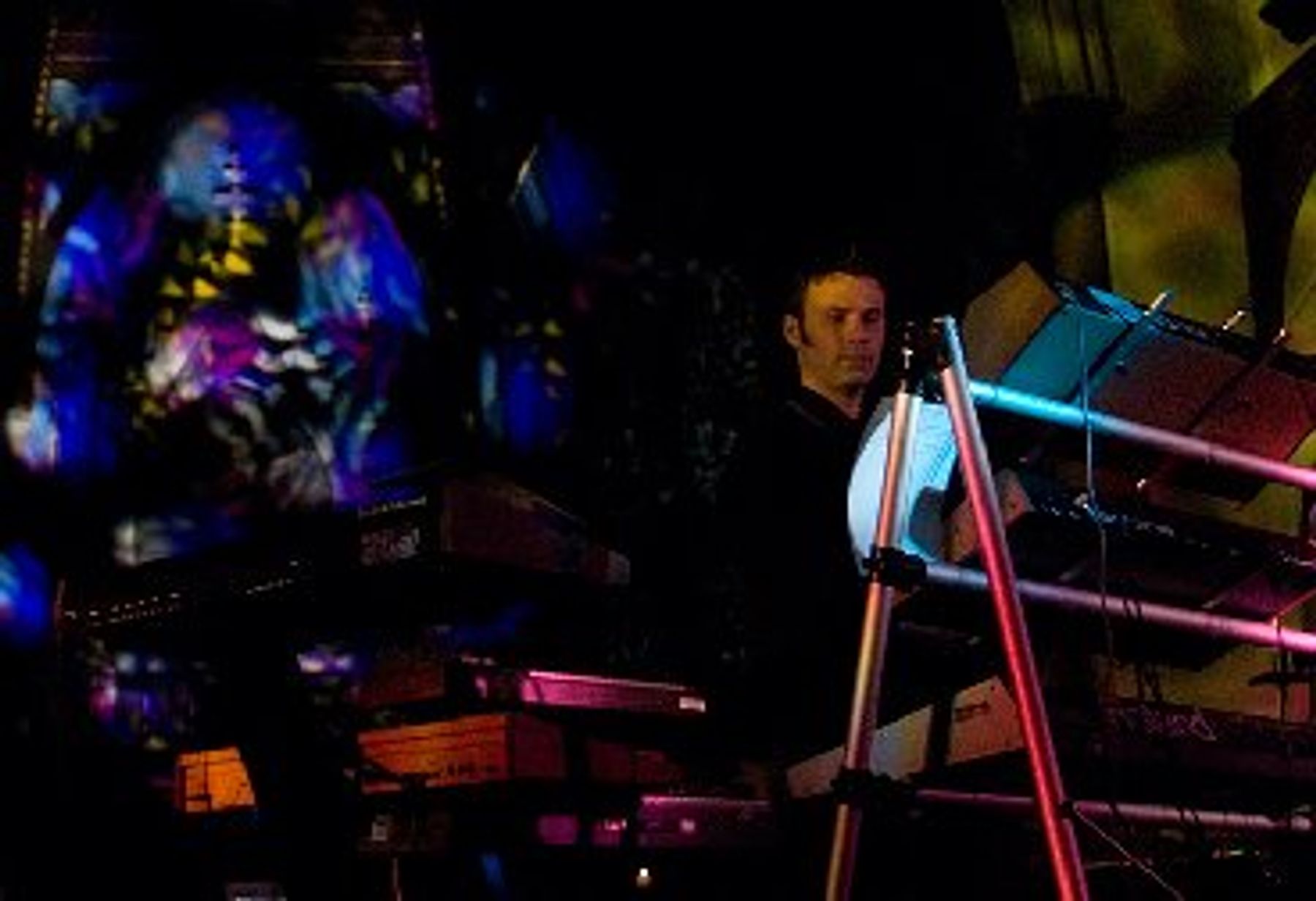
jeffrey koepper
jeffrey koepper
jeffrey koepper: Press
"Quadranteon" by Jeffrey Koepper
"Quadranteon" is the latest release from Jeffrey Koepper, once again recorded using analog equipment that results in a very organic seventies feel. Divided into four long form pieces all sequenced together for continued listening, "Quadranteon" is a disc that captures the classic sound of electronic music as established by such notables as Tangerine Dream and Klaus Shulz. With a detailed gear list for each track "Quadranteon" does a wonderful job of celebrating the analog sound.
From the sweeping pads that open "Part I", fans of the space music genre will feel right at home. Thick synth sounds drift through the track, leading into a mesmerizing sequence pattern that spreads itself throughout the soundfield, making the most of the space to create a vibrant and vital sonic environment. Tones circle around, complementing and contrasting each other, constantly shifting and evolving. The sound changes with "Part II", a more understated track that's darker and more subdued, a slowly evolving piece of music where pacing is everything and the spaces between notes are just as important as the notes themselves. Repeated musical phrases create a bed over which new sounds and feelings develop. The original theme in this track is a simple repeated three note motif, but as time progresses it becomes more of a drifting sequenced piece, eventually turning into a slow and distant dream of itself.
"Part III" brings a sense of hope and optimism to the mix, a more uptempo feeling that suggests growth and rebirth. There are a series of movements at play in this long form track, with lovely flowing ambience making up the first segment of the track, through the sequenced synthwork of the second movement (a percolating synth masterpiece that captures the analog ideal brilliantly), ending with the third movement which retains the sequences of the second, taking them in a more relaxed and dreamy direction. "Part IV" closes the disc with a similar dreamy vibe, with oscillating drones paired with pads resulting in a chilled synth soundscape where wind-driven tones pass through the mix, eventually closing out the track.
Koepper's work has always impressed me, from his debut release "Etherea" through his later discs "Momentium" and "Sequentaria". With the release of "Quadranteon" he continues to display his passion for synths in an entertaining and engaging way, creating some truly awesome electronic work that both celebrates and builds on a classic style. Highly recommended!!
"QUADRANTEON" is the latest Fall 2009--(5th release) from Berlin school electronic music master JEFFREY KOEPPER! This is first rate electronic music done up right...the way it was done in the 1970's using vintage analog equipment and retaining the human feel and ambiance that is lacking in so much of today's electro music. The atmosphere of all the classics can be experienced here. Klaus Schulz--Moondawn, Kraftwerk--Autobahn, Tangerine Dream--Richochet, The Nightcrawlers, Ashra--New Age of Earth! All the best stuff is inspired in the grooves of these tunes. Highly recommended-grade A Berlin school electronic excursions! Long tracks that take you to other planets and back. GRADE A....(If you have never bought any of his cds, start with this and work your way back through his entire catalog. It's all great stuff!!!
The man who goes by “Analog Jeff” has outdone himself on Quadranteon, truly going back to the classic Berlin school sound. On prior albums, Koepper has excelled at the Tangerine Dream sound from the Schmoelling era, tightly crafted tunes with lots of sequencing and vintage synth sounds. This is his first foray into lengthier compositions, and it is equally successful if not more so than its predecessors. “Part I” is classic space music, floating and swirling about, clearly on the edge of developing into something more, teasing the listener until the first sequencing appears just ahead of the 5:00 mark. A couple of minutes later another loop is layered over the top, deftly interwoven for hypnotic effect. A single wavering synth bridges over to “Part II”, followed by bubbly space transmissions. As TD did in their heyday, Koepper knowingly transitions from one theme to the next before any particular passage overstays its welcome. This 20-minute section explores the reaches of space without any rhythm or sequencing, content to float among the stars. Tangram and Pergamon are the reference points that come to mind. Sequencing finally appears again about 4 minutes in the 28-minute excursion of “Part III”. It moves briskly along for several minutes before pulling back briefly, then taking off again. “Part IV” hovers seemingly forever on a single, warm synth tone, with subtle shadings of atmospheric touches around it. It is a beautifully understated way to finish the album, with sweeping whooshes of sound that appear to be paying homage to the end of Jean Michel Jarre’s classic Oxygene album. Quadranteon may very well assume the mantle of classic status as well; only time will tell.
After four albums of tightly constructed, sequencer-based pieces crafted on restored analog synthesizers, Jeffrey Koepper has apparently decided to give himself a little more time and space to create longer tightly constructed, sequencer-based pieces crafted on restored analog synthesizers for his new release, Quadranteon. All the standard Koepper memes are here: cleanly pulsing, layered sequencer lines that weave around themselves with serpentine smoothness; spacey rushes of electro-wind bridging gaps; long, breathy spacemusic pads—all bearing that certain sonic seventies-ish something that marks the instruments at hand as coming from another time. What’s different on this outing is the length of the four tracks. Koepper has essentially written four short symphonies for an analog orchestra. Each piece here, titled only by its “Part,” glides through its own set of movements, telling its tale and expressing its fluid identities over the course of (respectively) 16, 20, 27 and 9 minutes. Koepper flows one part directly into the next for a seamless 70-minute ride. It’s a pleasure listening to him forge new directions in which to take the very distinct sound and feel of this subgenre of music and keep it fresh. At the same time, the easy familiarity that his sound evokes—perhaps particularly among (ahem) older listeners—helps to ground the experience and provide a nice point of reference. (And the references in question, which are obvious and well-noted in pretty much every Koepper review, are given their proper homage.) I particularly like the hypnotic “Part II,” which gives it first 10 minutes over to an unabashedly repetitious three-chord flow that eventually melts into a brain-massaging stretch of long-held pads that waver and warble like some nefarious alien device in an old sci-fi movie. You will lose chunks of time to this section of the CD because it’s going to lull you into a glorious nap-like stupor. Enjoy it. (Luckily, it gives way to the high-energy pulse and urgency of Part III, so you’ll wake right back up.) It goes without saying that fans of sequencer music will do better with Quadranteon than those looking for something less (apparently) clinical and programmed. But if you’re a Koepper fan and an analog appreciator, like me, those are exactly the qualities you’re looking for. In that, Quadranteon delivers nicely.
This release from 2009 features 72 minutes of dreamy electronic music.
Koepper plays a diverse selection of synthesizers and electronic equipment.
Dreamy atmospherics unfurl with cosmic stature, while each piece comfortably evolves into lustrous passages that glitter with keyboard embellishment.
Koepper establishes pacific backdrops, then stretches things out into elegantly extended intros. New layers are gradually accrued. Cyclic keyboards emerge with subsidiary harmonics. Spacey chords breathe into action and keep on coming. These various threads intertwine, producing a panorama of pulsations designed to separate the listener from reality.
There�s a delicate density here that manages to remain ethereal despite its understated puissance. Pleasant harmonics transform into melodic currents of mesmerizing charm. A delightful level of sonic enthusiasm is achieved and maintained.
While no percussion is utilized. When a rhythmic presence is achieved, it is done so through the application of repetitive keyboard strikes. This style maintains a sneaky manner of locomotion in the otherwise flowing music.
These are long-form compositions in which things progress slowly (but diligently), building from vaporous openings to enthralling passages rich with supernal characteristics, penultimately reaching cerebrally stimulating pinnacles which then recede into gentle outros. Koepper has an excellent command of this methodology.
Jeffrey Koepper's internal wiring seems at odds with modern times. In a culture where the ringtone passes for art and music is frozen and compressed into ninety-nine cent sound files Koepper's expressive use of Electronic Music equipment boldly aligns with the mechanisms of the mind rather than mere fleeting trends. His precisely programmed swirling Spacemusic seduces listeners into a kaleidoscopic inner-sanctum where time is suspended and the outside world fades away. His CD Quadranteon (72'25") was realized using a wonderful set of musical colors made on vintage analog gear - a process of going back to go further. The rounded tones of synth lead lines hover and float above ever-changing sequencer territory. With the structural divisions less clear-cut the four interconnected pieces progress through a mindscape of phase-shifted pads, windy white noise sweeps and contrapuntal fantasies of mechanistic synchronization. Koepper's echoing tone patterns capture the kinetic energy of traveling through space - this music without sharp dramatic climaxes is all about the journey. Koepper is excited by all that is going on in his music, and its features that seem to point far into the future.
“Quandranteon”, by analogue synth-wizzard Jeffrey Koepper, contains four extended parts in which he succeeds in stretching the boundaries of his vintage gearand their lovely, warm sounds a bit further. Not only does “AnalogueJeff” create the nicest range of sounds from his instruments, he also knows how to implement each of them into evocative compositions. Slowly rising out of retro effects and synth noise, the music smoothly evolves in each of the four “Parts” with attractive sequencing, immersive synth pads and solo voices. All the way the strong organic sound spectrum remains transparent, due to Jeff’s carefully and keen layering of textures.
“Quandranteon” is some tasty vintage stuff which one shouldn’t miss out on.
Bert Strolenberg
www.sonicimmersion.org
JEFFREY KOEPPER: Radiate (CD on Ricochet Dream
This release from 2009 offers 71 minutes of dreamy electronic tuneage recorded live at the Gatherings concert series in Philadelphia on April 14, 2008.
Luxurious harmonic threads ripple in the air like expanding banners, twirling around each other to form an exquisite helix of pulsating electronic sound. Each sonic strand embodies a glistening riff, some ephemeral, others comprised of keyboard loops. As the music unfolds, the tendrils meld into wondrous interaction and merge to create complex patterns of delicate melodic beauty.
As the concert progresses, the pace increases. The notes flash faster as if engaged in a personal race with each other. More demonstrative chords surface, mirroring the escalation. Rhythmics briefly enter the mix. A dramatic tension is achieved.
This level of activity follows a syne curve through the concert, rising to briskly animated passages, then plunging into stretches of slow-burning ambience, consecutively giving birth to new melodic coils and perpetuating the continuance.
Each surging rise and ethereal interlude display fresh substance, yet evoke a common mood of effulgent dreaminess. The stamina found in the livelier pieces maintains a gentle fluidity. A relentless flow is achieved as cyclic sequences combine to form engaging electronic assemblies.
The compositions are poignantly retro in style. Vaporous moods coalesce, evolving into multilayered tunes that flaunt a crystalline demeanor. The music seduces the audience into an astral trance tastily laced with sprightly passages.
The bulk of this live performance features material from Koepper's Sequentaria album.
There are a lot of sounds flashbacks that cross me ears listening the intro of Part I. From No Man’s Land (TD’s Hyperborea) to Equinox (JM Jarre), Quadranteon’s intro starts on cosmic steam which wave such as auroras borealis and roll as starlit foams waves. A sweet intro, with slow perfumed oscillations of synthesized breezes which mould a sweet and progressive rhythmic tangent that skips in a sound universe stuffed with synth to droning waves. Of this fine movement, animated of a warm synthesized life, flees tones of felted sirens which cross a spatial nebulosity battling against permutated sequences and fabulous solos of a poetic delicacy. Jeffrey Koepper's world is in constant harmony with a warm and boiling spatial music. An euphony created with accuracy by its analog gear and its personal vision of a fanciful cosmos, to moving constellations.
This 5th studio opus from the American synthesist pursues its mythical collection of the cosmic tones elaborated from sound searches, a creative imagination and a strong work of composition. Quadranteon is divided into 4 parts: 2 are very full of rhythmic lives and the other 2 are more atmospheric. A skillful musical blend that pushes the listener through 2 existential possibilities: the being and the non-being. If Part I is slowly animated by a pleasantly progressive rhythm, Part II plunges us into the spheres of a distant cosmos which we gravitate with sweet intoxication, as an ascent slowed down by the effect of weightlessness. Arpeggios float in echo, orbiting slowly Quadranteon timeless stairway. The sound world is skillfully built. Dressed it is by super analog effects which sway lazily on of beautiful skin-tight and waltzing stratas as well as minimalism chords which indicate and trace out the celestial way to be followed. A length (it is the first impression) but delicious journey as astral as meditative which overflows on the wild and biting Part III.
Juxtaposed synthesized waves float with romantic at the opening of Quadranteon best track. Part III is livening up on a synth to biting reverberations, announcing a pace which hems with a felted heaviness. Linear and minimalism chords follow with a sober frenzy which is accentuating with a new layer of keys so much minimalism, but intertwined by more crystal clear ones. Part III becomes more ardent and fuses of melodious synthesized tones which involve perfectly in this astral jungle to variables rhythmic pulsations which feed a structure more and more complex, all wrapped she is of heavy pads from a synth to the multiple musical variances. A brief atmospheric moment cuts the piece, which returns with a new hooked rhythmic structure mainly on a beautiful bass sequence coated progressively by a synth as vaporous as warm. A very beautiful and powerful track which joins the analogical lineages of the French era with Jarre on Equinoxe and Mercier on his delicious Music from France.
It is in the peaceful spatial that concludes Quadranteon, with the morphic and unctuous Part IV. There where the effect of floating in our head is also omnipresent as on Part II, but in shorter. A sweet and slow black waltz where furtive sliding cadences prevail on this binary measures. Beautiful and soft, warm and inviting! Reflecting this beautiful and poetic cosmic ode of Koepper who, year after year, invites us to his analog musical rendez-vous so unique in these days of contemporary gestation. If Jean Michel Jarre's first works appeal you, the music of Jeffrey Koepper is simply a must.
With this brand new release, Radiate, Jeffrey Koepper’s music has reached its zenith. Perhaps no one today makes sequential electronics as well as him. He layers melody, rhythmic energy and spatial vibrations into dynamic and celestial spacescapes that transports your mind far off into deep synthetic space.
I continue to be impressed by the high quality of Jeffrey Koepper’s releases, fantastic music in the style of late 70s and early 80s Tangerine Dream. As usual, Luminosity is filled with great sequencing, tight melodies, and beautifully atmospheric space music. The breadth and depth of Koepper’s talent is on full display within the first three tracks, starting with catchy moderately paced sequencing and synths on “Reflection.” In perfect contrast, “Light and Truth” is very airy, light but not insubstantial, full of bright shimmering tones in relaxed sonic hues. “Artifacts” goes pure retro, but in a stripped down way, using three synths to capture the essence of the old classic Mellotron flutes, strings, and a simple cadence in the background to keep time. It is wonderful in its sparseness, as is the next track, “Winter Space.” In fact, this is a considerably mellower affair throughout than its predecessor, Sequentaria. “Life Clock” continues the easygoing pace, ticking slowly with cool space twitters along the way. The lead synth line here is very reminiscent of vintage Klaus Schulze. Gently pulsating sequences pick up the tempo a little on the next couple of tracks, but throughout the disc shows considerable restraint, focusing on setting a hypnotic mood and maintaining it, particularly in the case of the 11-minute “Transmission,” the longest track and yet the one you may miss most after it fades. “Dusk Till Dawn” is the most minimal track, mostly water and low drones, with a sparse melody toward the end, very cool. “Rising Sun” is a warm, relaxing number to finish off a great album in style.
© 2009 Phil Derby / Electroambient Space
Jeffrey Koepper – Radiate
CD, Ricochet Dream, 2009
“Radiate” is the first live cd of “AnalogueJeff” Koepper, documenting the concert he did at The Gatherings on 14th April, 2008 in Philadelphia. Well, the outcome is an 71-minute energetic, analogue feast, featuring all tracks (except “Near Machinery”) from his album third album “Sequentaria”, to which “Byzantine Machine” (the opening track of “Momentium”) and “Rising Sun” (from “Luminosity”) are added.
Fans of vintage music will sure enjoy this album, of which the final mastering again was done by Steve Roach.
JEFFREY KOEPPER: Luminosity (CD on Air Space Records)
This CD from 2009 offers 73 minutes of gentle electronic music.
Delicate keyboards are augmented by atmospheric electronics, resulting in tuneage of superior distinction.
Utilizing airy tones, the keyboards fashion ethereal melodics that lend calmness a glistening demeanor. As chords sigh to each other, generating swaying pulsations, moods of serenity are established, rich with the promise of potential enlightenment.
Some of the electronics convey an arid quality, the notes wavering and rising like heat from a vast plain. Once airborne, the chords resist breezes, drifting under Koepper’s meticulous guidance. Their movement becomes sideways, punctuated periodically by the chortle of synthetic bubbles.
While percussion is unnecessary, there are passages that use blooping cycles to approximate gentle rhythms. These beats blend nicely with the flowing electronics, masking themselves from obvious notice.
At times, the placid mesmerization falls away as the riffs mount in puissance, expressing a gradual accumulation of vigor. These ascensions swell with gathering majesty, peeling away the listener’s stress and inciting optimistic anticipation.
A dreamy disposition marks these compositions. The tunes are soothing yet inherently stimulating. These type of harmonic melodies etch themselves into the cortex and emerge later on as idly hummed riffs. Their streaming nature is designed to slowly mutate as they progress, doing so covertly while remaining basically loyal to a central theme.
Radiate is a sonic document of his set at The Gatherings and traverses much of the same territory as his two previous concert outings (on STAR'S END and opening for Steve Roach). With an emphasis on works from his new CD Sequentaria (released at The Gatherings that night) the set began with some vintage phase shifted synth pads, heroic E-drums and dancing arpeggio scales. Drawing on the musical era that spawned such albums as Poland, Logos and White Eagle; Koepper ran through a fascinating range of sequencer based pieces - his full-throated lead lines soaring above. His stage set-up included several keyboards, among them vintage museum grade synths - right alongside the latest retro analogue technology. Between each of the rhythmic sections Koepper lulled the audience with deep drones and airy synthetic harmonies and effects. To close out the night, Jeff played lovely chord progressions on the Prophet-8 over a simple run of tones from the arpeggiator on the Jupiter-6. Looking back, this uncluttered and pure piece of music was a perfect way to wind the concert down - with a few quiet and intimate moments spent between the artist and audience. At The Gatherings Concert Series complex stories are often told with simple sounds. Radiate is full of these human details, spoken in the public luster of the live concert.
In his exploration of analogue synthesis, Jeffrey Koepper continually comes up with music less lab experiment than works of personal expression. On Luminosity (73'32") Koepper realizes nine multi-layered and multi-faceted electronic pieces that fit nicely alongside precedent releases by acclaimed Spacemusic luminaries. The distinguishing characteristic of Luminosity is its cerebral (sometimes solemn, sometimes ecstatic) energy. This CD achieves the heights of Koepper's best work all the while reaching into the depths for meaning - taking us even further into Koepper's creative center. Avoiding digitalism he leads listeners on a heady musical journey full of Mellotron pads, buzzing filter sweeps, simple waveforms and a complex landscape of synchronized sequencer controlled patterns. Stepping through each measure, the machine-like rhythms repeat and grow additional lines - each in and of itself a deceptively simple arrangement of rests and notes. Taken together this music works as a mysterious system that perfectly occupies a plane where the human spirit, music technology and the cosmos coexist.
Jeffrey Koeppers 4th solo album is titled LUMINOSITY and it is just that. Musically it combines gorgeous melodies and atmospherics with ebbing and flowing themes at times propelled by rippling, thundering sequences. Over the span of his albums each has complemented the other beautifully. Taken as a whole they make for absolutely captivating listening.
This release from 2009 features 72 minutes of dreamy electronic music.
Koepper plays a diverse selection of synthesizers and electronic equipment.
Dreamy atmospherics unfurl with cosmic stature, while each piece comfortably evolves into lustrous passages that glitter with keyboard embellishment.
Koepper establishes pacific backdrops, then stretches things out into elegantly extended intros. New layers are gradually accrued. Cyclic keyboards emerge with subsidiary harmonics. Spacey chords breathe into action and keep on coming. These various threads intertwine, producing a panorama of pulsations designed to separate the listener from reality.
There’s a delicate density here that manages to remain ethereal despite its understated puissance. Pleasant harmonics transform into melodic currents of mesmerizing charm. A delightful level of sonic enthusiasm is achieved and maintained.
While no percussion is utilized. When a rhythmic presence is achieved, it is done so through the application of repetitive keyboard strikes. This style maintains a sneaky manner of locomotion in the otherwise flowing music.
These are long-form compositions in which things progress slowly (but diligently), building from vaporous openings to enthralling passages rich with supernal characteristics, penultimately reaching cerebrally stimulating pinnacles which then recede into gentle outros. Koepper has an excellent command of this methodology.
His newest cd for 2009,Luminosity. This is JEFFREY KOEPPER'S 4th release and it's the *BEST ONE* so far!!! This artist just keeps getting better all the time. Beautiful soundscapes for fans of ENO, TANGERINE DREAM, ASHRA, STEVE ROACH, KELVIN SMITH, MICHAEL GARRISON, and HAROLD BUDD. GRADE A Electronic instrumental music!
Analog lovers will find plenty to enjoy in Jeffrey Koepper's 2008 and 2009 releases, Sequentaria and Luminosity. Seated in the cockpit behind his refurbished old-school synths, Koepper takes listeners on deep journeys that alternately cruise at warp speed and drift through quiet nebulae. Jeffrey has a way of bringing a very organic touch to the cybernetic precision of sequencer-based music. The punchy “Blue Sector” kicks off Sequentaria by pulling gently awaty from the dock on long pads and then jamming the engines wide open in classic space-funk style. It docks neatly into “Astral Projection,” a trippy bit of knob-adjusting pleasure wherein wet, mutant sounds evolve into lush, falling pads and shivering synth-spirals under the watch of a slow-but-vigilant bass tremble. “Timeline” hypnotizes the listener with balanced sequencer lines in both ears that build to a dense cluster of sound and an invasive beat that Koepper builds with an invisible hand. It fades nicely into the broad washes and twiddle of the start of "Near Machinery"--another instance of Koepper lulling the listener for a few minutes before kicking it into overdrive. The wave-form drift, delayed-echo melodies and spacey twiddle of “Interphase” follows, a nice mid-speed cruiser. With the clockwork-precise weaving of sequencer lines in "Synchronous" Koepper returns to his dense-layering ways, one subtle enhancement at a time. “Parallel Being” follows, moving from a dramatic drone-based beginning to an easy-flowing piece with a subtle Asian flair as woodwind-synths trade melodic lines. "One Hundred Memories" is another exercise in layering paired with spacey chord runs. And then...
"Creation," the last track on Sequentaria, is Koepper at his funky finest, opening with a long drone that begins to morph under a rising beat before the whole thing just breaks loose, layer upon high-octane layer, for 10 glorious minutes of full-out spacegroove.
"Luminosity" seems, to these ears, to be a bit more hands-on, and certainly softer than Koepper's earlier works. Soft woodwind sounds abound. This one eases into the background more readily than other outings. There are, obviously, similarities--"Reflection" opens sounding very much like "Between Dreams" from the Etherea CD, "Transmission" will readily remind you of "Creation" once it gets cooking around the 4-minute mark, and "Dusk Til Dawn" is a close cousin to "Astral Projection."
But altogether, both disks are an excellent additon to the Koepper canon and go a long way toward keeping the analog torch lit. Koepper's getting better with every new release and has become, for me, an artist I look forward to hearing more from. Find his work at his web site or at the Steve Roach site.
On the threshold of the new year, I received the fourth album of “AnalogueJeff” Koepper which is due for mid-January 2009. With “Luminosity”, Jeffrey Koepper wanted to explore ambient emotional places. To achieve this, he made each track a unique atmospheric landscape on which he wanted the electronic textures to engulf the listener's mind and take them to another place and time. In this process, Jeffrey used a combination of sequencer rhythms, ambient textures and different moods to create these emotional sonic worlds. These worlds itself were comprised of many analogue elements that combined and formed into lush structures.
As such, the goal was to create a very organic, flowing feel on this sonic journey, getting access to different moods, ranging from sombre peacefulness to ecstatic and hopeful. The nine tracks on the album (again excellently mastered by Steve Roach) continue to breath the honest, warm and immersive atmosphere of analogue gear as we know it from his former releases. But this time I have the impression Jeffrey has given his music more time and space to evolve, which is nicely shown by the opening piece “Reflection” and the slow morphing soundscapes of “Light and Truth”. The slow pace of things is also found in “Winter Space” and “Life Clock”, both soft glowing and flowing tracks with immersive, melancholic undercurrents. More sequenced, rhythmic outings are found in the second part of the album with the tracks “Emitter” and “Transmission” (of which the latter especially feels like a smoothly evolving voyage) before things slow down again with the free form textural “Dusk Till Dawn”, which is the only piece which sounds a bit light-weight compared to the others. Fortunately, the happy sequencings of “Rising Sun” return to the aforementioned quality.
Bert Strolenberg
www.sonicimmersion.org
Third time is indeed a charm in Jeffrey Koepper’s case—Sequentaria demonstrates a guy who can’t be stopped, and no one should try. A man so in love with electronic sound and its capabilities that he proudly lists the equipment used for each track (though granted this is practically de rigueur amongst synth aficionados), Koepper possesses some extraordinary compositional dexterity and a flair for the dramatic that enable his roaring electrifications to deflect whatever cursory TD glances are thrown at them. And those referents exist in abundance: “Blue Sector” dodges bullets shot out from Hyperborea and Tangram; “Astral Projection” and “Near Machinery” feloniously challenge Thief’s similarly sleek, fleet, streamlined assaults; “Synchronous” is simply pure sequencer dazzle, informed by a supine grace underpinned with stealthy ferocity. Comparisons, influences, quotation marks aside, Koepper’s creations dare you to holler “foul!”—svelte and savvy, a smooth operator twisting knobs in a display of balletic razzledazzle, it’s apparent to anyone well-schooled in, well, Berlin school techniques, that Koepper’s malleability, his honest embracement of the Teutonic birthright, oozing the right stuff, neuters any charges of “retro” that might be levied. Once sent spiraling across the ten-minute breadth of “Creation”, as Koepper’s sequencers Prophet-ize a simultaneous second coming of Richard Pinhas’ own fevered (tangerine) dreams, the only necessary choice is one of total submission to its onslaught. Smashing. DARREN BERGSTEIN •
JEFFREY KOEPPER: Sequentaria (CD on Air Space Records)
This release from 2008 offers 71 minutes of masterful electronic music.
This time, Koepper did it all, with final mastering by Steve Roach.
A masterful confidence permeates the electronics on this album. Tonal foundations are fairly buried beneath layers of enthralling lead riffs that intertwine to produce a lavish tapestry of delightfully compelling tunes.
Sparkling loops and gurgling textures provide ample ambience, but Koepper’s manner of nudging these aspects into the forefront of the mix enlivens the music. This luscious dominance results in a constant state of blossoming brilliance These songs exude an immensely appealing sophistication bursting with electronic vitality and bewitching melodies.
Keyboards introduce even more threads to that crowded tapestry, resulting in melodies that are dense but not ponderous. Cycles are established, then embellished slowly, hiding their evolution in the thick mix, only to pop forth ripe with entrancing splendor. Stunning pinnacles abound in these tunes.
E-perc serves to boost a few tunes with bouncy rhythms. Other tracks rely upon strident keyboard patterns to establish a rhythmic presence; these low-impact tempos often possess more oomph than any percussion could produce.
Koepper’s ability to imbue simple riffs with lofty eminence is astounding. His tendency to combine numerous minimal elements into lavish structures of pulsating puissance is guaranteed to be an ultimate satisfaction to EM enthusiasts seeking music that bridles with energized vigor while retaining a mesmerizing edge.
The compositions flourish with a rich sense of regal command. These soothing melodies generate a pronounced invigoration, gradually accruing power with each subsequent passage until an impressive stage of epicurean grandeur is achieved.
Jeffrey Koepper’s third release Sequentaria finds him fully in retro mode, with catchy melodic EM in the style of Tangerine Dream from the early 1980s, perhaps my favorite era of theirs, with the trio of Froese, Franke and Schmoelling. For example, “Blue Sector” sounds like it could have fit comfortably on Exit. The simple pulsing rhythm, the cool vintage sounds from the PPG Wave, the stutter-step sequencing, it all plays out perfectly for a warm and inviting beginning. “Astral Projection” starts out all bubbly and spacey, taking its sweet time before hypnotic sequencing again envelops you. The pacing on “Timeline” is particularly effective, chugging along just so. Classic synth lead lines will have Teutonic enthusiasts in heaven. “Near Machinery” is one of my favorites, a perfect blend of soft, rapid sequencing, adept synth solos, and warm pads. “Interphase” gives a nod to Jean-Michel Jarre with its tinkling crisp percussion that harkens back to the days of Oxygene. Each selection is allowed just the right amount of time to develop and set the mood before moving on to the next juncture. And to the delight of gearheads, Koepper gives the complete run-down of the synths and sequencers used on each and every track. Required listening for Berlin school fans.
Jeffrey Koepper
July 2008
For more background on this month’s interview subject, solo American synth artist Jeffrey Koepper, please read his bio page on his website. Thanks Jeff for the interview, I really appreciate it!
In April you performed at The Gatherings concert series. How did that go?
The Gatherings concert went great. Chuck Van Zyl and his crew are great guys to work with and everything went off without a hitch. I think that is the best venue to play live electronic music - being an old stone church the sound is incredible and it is visually very inspiring. I have become spoiled playing there. It doesn't get much better than that for atmosphere.
How does playing this sort of music live compare to being in the studio?
Playing live is like nothing else, it is an incredible feeling. For me it is very different from the studio. The studio is a more controlled intimate solo experience, where it is just you and the machines creating. Live has the energy of the room and the audience which can really build an intense feeling. This feeling in turn will take you into new directions for the compositions.
Your music has a very "composed" feel to it. How much does improvisation play a part in your creative process, versus carefully planning things out?
Well, I would say my music is mostly improvised and done in the moment, inspired by the feeling of the moment. I rarely plan and compose music before I go into the studio. In the studio I work with the machines and the different interfaces they offer, these interfaces in turn influence the music and how I make music. I try to get as much of the composition going as possible and then capture it live to a two track mix. I feel that captures the life and energy of a piece. I may then add some textures and sounds during a final mix. That way the feeling of the composition is captured and there is still room at the end to fine tune and finalize a piece.
On your website, at the end of a long list of familiar musical influences in EM and synth-pop, you go on to mention "Arp, Oberheim, Moog, Sequential Circuits and many others." So how important is the technology in making good electronic music? And how is it an "influence"?
The technology I use to make music is very important. I feel the type of musical equipment you use directly influences the style and direction the music will take. I list companies such as Arp, Oberheim, Moog, Sequential Circuits and others as influences because the sound and interface they offer directly influences how I work on a composition. I also feel that most of the music I like and that I was influenced by was done in the past using that type of equipment; that is proof enough for me. I could be called a Luddite in the fact that I don't use a computer at all in the studio. Everything I use is hardware, down to an analog mixing board and recorder. I could never work in the "mouse controlled" world of computer recording and soft synths. I just can't connect to that world.
Your list of gear is impressive. How were you able to amass such an impressive collection for your studio?
The gear and old technology has always been important for me from day one. When I first got into music and bought my first synthesizer in 1985, it was analog. The funny thing was analog was on its way out of fashion but I just knew from day one I loved analog synths. People would say to me back then "why do you want that old junk" but I didn't care, I knew what I wanted. During that period the prices of analog synths dropped very low because there was little or no interest in them from most musicians. So you were able to buy them reasonably priced. But little by little people started to realize that analog synths were incredible machines and not outdated, so now the prices are back up to where they should be in my opinion for such wonderful machines.
Do you have a personal favorite in your synth collection?
I really can't say I have one favorite synth, they are all so different and good at different things. I love the aspects of the synths that give them their unique personality. For example ARP instruments are very different in tone to the Oberheim synths but I like both just as well...they all have their applications. So I guess I love them all equally. But I do really love everything Arp has done. :)
Your discs have a very professional look and sound, from the packaging to the music. How do you manage to do it all yourself?
Wow thanks for that. I try really hard to bring the best product I can to my audience. I put alot of time and effort into creating and recording the music. I want it to sound beautiful and lush. Steve Roach has been great with mastering my records. He's a great guy and I appreciate what he does. Also the packaging and art is important to me, I grew up with records and incredible 12 X 12 album jackets. I miss that format alot. So with my releases, I try to make them like mini album covers with the digipak format.
Will you remain strictly a solo act, or have you considered collaborating with others? If so, who would you like to work with and why?
I am always open to collaborations, given the members both have something unique to offer. I have collaborated with others in the past and there have been some great musical moments. I really enjoy the feeling of creating new pieces in a group situation. Working with others can lead you in directions you would have never ventured to on your own. As far as people I'd like to work with in the future, I'd love to do a project with Steve Roach, I think that would be very cool.
What is your favorite part about making music?
Well, there are so many aspects I love about making music, it’s hard to pin it down to one. I guess one thing that I really love is the creative spark that happens when composing and a piece starts coming together and coming alive. It is a feeling like no other. This feeling can give me the chills and make you very high and that feeling is also addictive, once you experience it you want it more and more. Another aspect I love about making music is using the older technology to create and bring that to the world. I like to show what is possible using just vintage hardware synths and sequencers. I feel that there is still a lot of good work to be done with this technology and many new directions to explore.
With all the time spent creating music, do you get much of a chance to listen to others? Who are some of your favorites, EM or otherwise?
I do listen to music all the time. I tend to listen to a lot of music that was recorded in the mid seventies to the early to mid eighties. I like the sound and production style of this period. I like the classic EM artists as well as the early eighties electropop artists.
In fact, in addition to the ambient music scene, I do early eighties influenced analog electropop music under the name Wire Service.
Do you listen to your own CDs after you are done with them, or do you tend to move on to the next thing?
I tend not to listen to my CDs for a while after I release them. During and production and mix down you can really over listen to a piece. I will usually go back after about a month and listen to the CD after it is fresh to my ears again and check it out.
Who is your "trusty assistant" in the photos section of your site?
My trusty assistant is my dog Kali, she is a chuiabull, which is a chuiahuia/pit bull mix. She is a great assistant and helps me with inspiration and with all my compositions.
When you aren't making music, what else do you like to do?
When I am not making music I like to restore, build and repair analog synths, this is good for me because I can keep up the studio in great working condition and is necessary. I like to hike and camp and get out into nature whenever possible. I also like to restore and play around with old Volkswagens so I keep pretty busy.♫
Thanks again Jeff for the great interview - we hope to hear from you again soon! Check out Jeff's latest CD Sequentaria, which was reviewed in the June 2008 issue of EAS.
Jeffrey Koepper's latest release "Sequentaria" is a wonderful selection of brilliant analog tracks incorporating a wide variety of synths that create a very organic and traditional space-y electronic sound. The result is a fascinating and engaging sonic journey to the stars and back with Koepper as your guide.
"Blue Sector" opens the disc with a beat-driven sequenced track that establishes the space imagery, the sounds of a trip deep into the stars. Deep pads and sequenced tones play around eachother, blending and feeding off of one another resulting in a dense yet accessible piece that evokes images of stars and nebulae passing by, the inky black depths of space the only constant in an otherwise shifting landscape.
"Astral Projection" blends in seemlessly from the preceeding track. Fluid tones ooze up from a molten opening, building in volume and strength, ultimately leading into a bubbling bed of sounds that flow and ooze through the soundscape. A great track to be sure.
"Timeline" has an alien quality to it, elongated tones that suggests decaying civilizations and lost cultures. It's a haunting piece, a track filled with ghosts and long forgotten memories, sounds rising up from a slowly churning bed of pads, eventually gaining clarity and form in the shape of a sequenced line that accompanies a very nice analog melody.
Track four, "Near Machinery", opens with the sound of flowing pads and tide-like tones, eventually leading into a fast and frenzied sequencer line that dominates the track. High pitched synths play an oblique melody overtop the sequencer work and small melodies come and go as the track continues. Very nicely done.
"Interphase" is a return to familiar spaces. A nice highhat driven rhythm moves the track along, while shifting pads flow and circle around eachother. Occasional tones pass through the soundscape, adding a nice colour to the track, some celestial seasoning as it were. It's a nicely executed track, one that very effectively suggests the idea of space travel.
"Synchronus" is a fine example of sequenced synth work, repeated patterns looping around eachother to create a wall of sound that grows and develops as the track goes on. As time passes more elements are added, often subtle at first, but becoming more noticeable as the track continues. A very nice demonstration of how a track can be built up and developed.
"Parallel Being" follows directly out of the order of the previous track, opening with a more free form sound grounded by a steady drone. As the track continues steady synthlines weave their way into the soundscape, along with light percussive elements paired with some nice melodic work. It's a playful track, one that incorporates a variety of styles and sounds to great effect, and surely one of my favorites on the disc.
"One Hundred Memories" returns to a more sequence driven sound, tones growing organically as the track progresses. It's a nice blend of sequenced and live work, looping patterns facing off nicely against melodic elements.
"Creation" closes the disc, building up the track from a single oscilating tone, adding both melodic and percussive elements as the track continues until it eventually becomes a brilliant wall of sound, tones and melodies mixing and wrapping around eachother in an engaging way until the track peaks and then drifts away. A very impressive track and a lovely way to close the disc.
I've often speculated on what it is that makes analog recordings so spacey to me, what it is that conjures such cosmic imagery. I've never been able to come up with an answer that satisfies, but listening a disc like "Sequentaria" I can totally hear that spacey sound that I'm so fond of, and an answer to my question seems far less important to me than being able to wander through the stars. An excellent disc for wandering, listening and just imagining, "Sequentaria" comes highly recommended by this reviewer.
rik - ping things
Next Page >>